Libby & Sora Reads Shares a Mystery for All Ages: Secrets of the Broken House
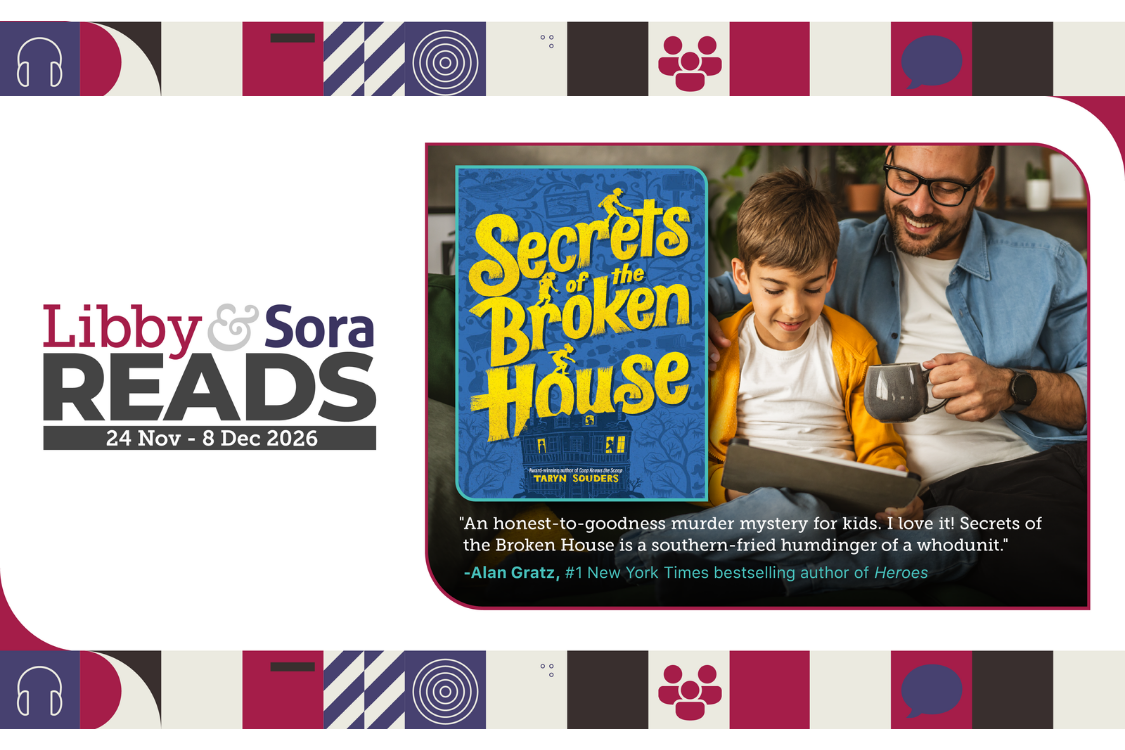
Get ready to bring readers together for the next Global Libby & Sora Reads program! From November 24 through December 8, readers can discover Secrets of the Broken House by Taryn Souders and join a shared reading experience through their libraries.
Perfect for fans of mysteries, memorable characters, and small-town secrets, Secrets of the Broken House offers plenty of opportunities for creative library programming, from mystery-solving challenges for young readers to book discussions exploring human nature, relationships, and the consequences of holding a grudge.
 About Secrets of the Broken House
In the small Southern town of Everson, goats can run for mayor, the mail is always late, and nothing particularly bad ever seems to happen. That changes when thirteen-year-old Tucker discovers Miss Geraldine dead at the bottom of her stairs.
At first, her death looks like an accident. But Tucker has a knack for noticing details others overlook, and the evidence doesn’t quite add up. As he investigates, he discovers that Miss Geraldine was murdered—and that nearly everyone in town seems to have a reason to want her dead.
With secrets, suspicious characters, and danger around every corner, Tucker must figure out what really happened before he becomes the next victim.
In Secrets of the Broken House, author Taryn Souders combines an engaging mystery with themes of human nature, forgiveness, and relationships. It’s a compelling choice for young mystery fans and an excellent starting point for conversations about character motivations, critical thinking, and how our choices affect others.

A Letter from Tara Souders
Taryn Souders graduated from the University of North Texas with a specialization in mathematics. She is the author of Edgar-nominated Coop Knows the Scoop, How to (Almost) Ruin Your Summer, The Mystery of the Radcliffe Riddle and Secrets of the Broken House. She lives in Winter Park, Florida, with her family.
Dear Reader!
I’m so glad you picked up Secrets of the Broken House. Thank you for choosing to spend time with this story, its characters, and the mystery tucked inside its pages.
Mysteries have long been my genre of choice—whether I’m reading them, writing them, or watching them on TV. As a kid surrounded by whodunits, I was right there with the detectives, trying to solve the case before they did. But it wasn’t until I discovered Agatha Christie that my love for murder mysteries truly sparked. And as I’ve talked with young readers, I’ve found they want those kinds of stories too. That desire inspired me to write Coop Knows the Scoop, The Mystery of the Radcliffe Riddle, and my newest book, Secrets of the Broken House.
So…what is Secrets of the Broken House about? I’m glad you asked. This book is more than just a story about solving a crime. It’s about friendship, forgiveness, and learning how holding on to grudges can sometimes hurt more than the thing that caused them in the first place. It’s also about acknowledging the idea that justice isn’t about being well-liked; it’s about doing what’s right.
In the quiet Southern town of Everson, Georgia, thirteen-year-old Tucker Stephens is used to life being borrrrrring. But that all changes when Miss Geraldine Guss—a world-class grudge holder if ever there was one—is found dead at the bottom of her stairs. What first seems like a tragic accident quickly turns into something far more serious…murder.
One of my favorite parts of writing this story was creating Tucker Stephens. Tucker is smart and always noticing things other people might miss. His knack for observation and deduction has earned him the nickname “Sherlock” from his friends—and I must admit, that makes me smile every time I write it. Like Sir Arthur Conan Doyle and Agatha Christie, I had so much fun crafting my own detectives who have to rely on both their wits and their hearts to solve a case.
If you love reading mysteries (or even just figuring out puzzles and patterns), I hope this story becomes a favorite.
Happy sleuthing!
Taryn Souders
School librarians and teachers can check out our Educator Blog for information on how to enter for a chance to meet the author, add signed books to your classroom library, and bring a little extra excitement to your students’ reading experience.
Programming & promotion ideas for your library
Looking for ways to bring Secrets of the Broken House to life for your community? These programming suggestions draw inspiration from the book’s mystery, its memorable characters, and Souders’s reflections on reading and writing.
From low-prep displays to hands-on activities, there’s something for libraries serving readers of all ages.
Easy ways to promote the program
Help readers discover Secrets of the Broken House through these easy to implement program ideas.
- Create a mystery-themed book display. Feature Secrets of the Broken House alongside other middle-grade mysteries, whodunits, and books with surprising twists. Add a sign asking, “Can you solve the mystery?” to invite readers to explore.
- Promote the program on social media. Share the November 24–December 8 dates and invite patrons to join the community reading experience. Ask followers to comment with their favorite mystery novel, a memorable fictional detective, or a book that made them see a character differently.
Download the free marketing kit on the resource center.
- Create a digital reading recommendation list. Pair Secrets of the Broken House with other mysteries and character-driven stories available in your digital collection. Include a mix of ebooks and audiobooks to accommodate different reading preferences.
- Build a “Walk in Their Shoes” display. Inspired by Souders’s experience of relating to a character of a different age, feature books that encourage readers to connect with people whose lives differ from their own.
Active programming for readers of all ages
Mystery at the Library: A Clue-Based Challenge
Best for: School-age children, tweens, teens, families
Turn your library into a mystery-solving destination with a fictional case for patrons to crack.
How to run it:
- Create a short fictional mystery involving a missing object, a suspicious event, or a puzzling series of clues.
- Set up four to six clue stations around a meeting room or designated library space.
- At each station, participants gather information, eliminate possibilities, and record their theories.
- At the final station, participants submit their solution and explain which clues helped them reach their conclusion.
- Reveal the answer and discuss how different people may have interpreted the same evidence.
Make it a reading connection: Encourage participants to consider how Tucker investigates the mystery in Secrets of the Broken House. Which details might he notice that others overlook? How can an author’s use of clues influence a reader’s suspicions?
For a simpler version, create a one-page mystery handout that patrons can complete at their own pace.
their possible motives. Readers who haven’t finished the book can participate using a separate mystery story or a librarian-created example to avoid spoilers.
For adult programs: Expand the discussion to include unreliable narrators, red herrings, and how mystery writers manipulate reader expectations.
Write Your Own Mystery: A Creative Writing Workshop
Best for: Tweens, teens, aspiring writers, writing groups
Inspired by Souders’s approach to writing mysteries, invite participants to create a short mystery of their own.
How to run it:
- Begin with a simple scenario: a missing library book, an unexplained noise, or an object that disappears during an event.
- Ask participants to create three characters, each with a possible motive or an important piece of information.
- Have them write three clues, including one that could initially mislead the reader.
- Encourage participants to exchange stories and see whether their partners can solve the mystery.
- Finish with a discussion about how to make a mystery challenging but fair.
For younger writers, provide a fill-in-the-blank story template. Older participants can experiment with unreliable witnesses, hidden motives, and unexpected endings.
Discussion prompt: How can a writer let young characters solve a mystery in a believable way? What information should the reader know, and what should remain a surprise?
Make it accessible: Provide large-print materials where available, allow extra browsing time, and offer both print and audio excerpts.
From Grudges to Growth: A Book Discussion About Relationships
Best for: Teen book clubs, adult book clubs, family discussion groups
One of the central themes in Secrets of the Broken House is the harm that can come from holding a grudge. Use the novel as a starting point for a thoughtful discussion about relationships, misunderstandings, and forgiveness.
How to run it:
- Invite participants to identify a conflict between characters in the book.
- Discuss how the characters’ assumptions or actions influence the situation.
- Ask what might have happened if a character had chosen to communicate differently.
- Explore the difference between forgiveness, reconciliation, and setting healthy boundaries.
- Invite participants to write a private reflection about a lesson they have learned from a fictional character.
Keep personal sharing optional. Participants should be able to discuss the characters without feeling pressured to disclose their own experiences.
For a family program, adapt the activity to focus on friendship, empathy, and ways to resolve everyday disagreements.
Join Global Libby & Sora Reads
From November 24 through December 8, invite your community to discover Secrets of the Broken House by Taryn Souders and take part in a shared reading experience. Contact your Account Manager with questions.
Use the program as an opportunity to promote your library’s digital collection, encourage readers to explore a new mystery, and create activities that bring patrons together around books.
Whether you’re helping a young reader solve their first fictional mystery, connecting generations through favorite childhood stories, or leading a discussion about the complicated relationships that make characters feel real, there’s plenty of room to make the program your own.