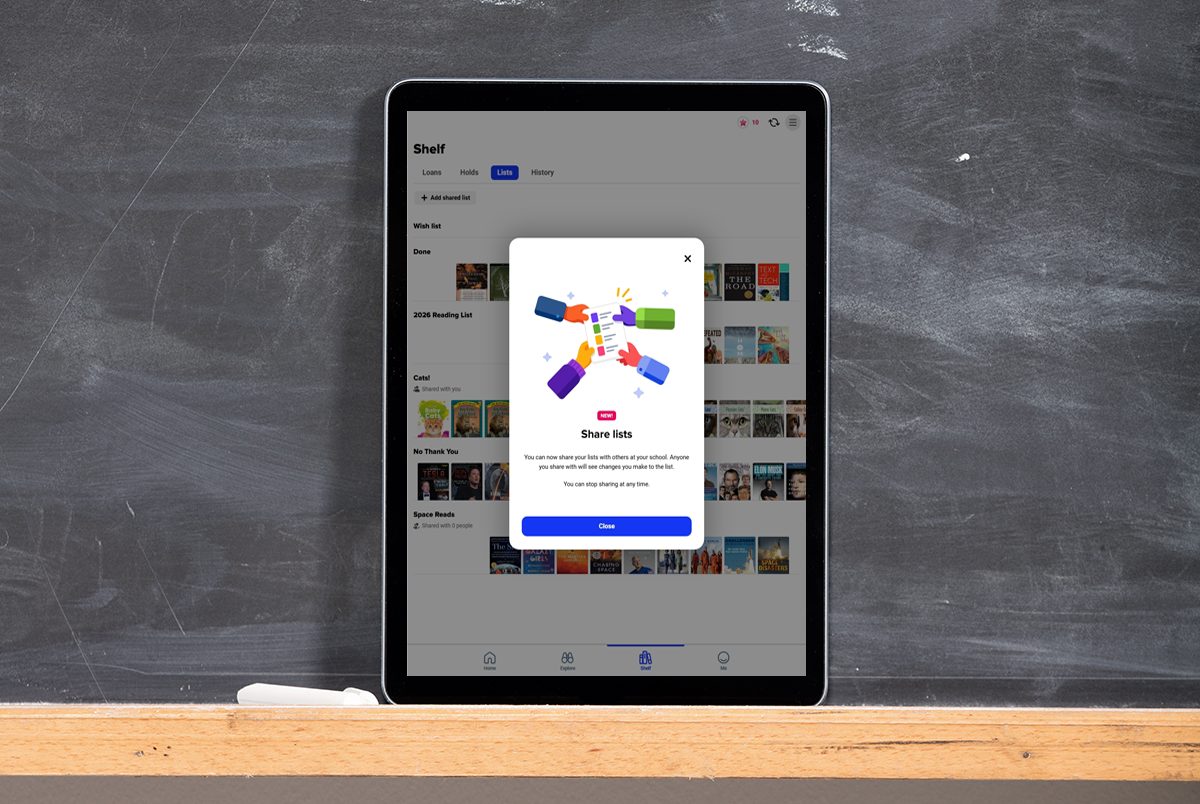
Making reading connections, one shared list at a time
Learning doesn’t happen with the snap of a finger. It happens in moments. Teachable moments, aha moments, moments of frustration and overwhelm, moments of discovery and reflection.
While these magical moments are powerful, they’re often unpredictable.
- In the middle of a well-crafted lesson plan, a teacher realizes her students are missing the background knowledge they need to make meaning from the topic.
- A student finishes a book they truly loved—and the next 14 seconds determine whether he’ll open the next title in the series or swipe straight to YouTube.
- In front of an entire class of high schoolers, a principal is asked how any of this reading will matter after graduation
Each of these moments comes with an opportunity to make connections, but because of their unpredictability, it’s difficult to prepare for them.
That’s where Sora’s newest feature comes in. Lists in Sora are now shareable, so educators can quickly respond to shifting student needs with texts that spark curiosity and build reading momentum.
How can shareable lists help you make the most of these moments?
When a teacher needs something yesterday…
Even the best lesson plan can be thwarted, but shared lists give teachers flexibility to respond to changing student needs in real time. In practice, this may look like:
- Sharing small collections of texts when student questions take a lesson in a new direction
- Providing content to build background knowledge before continuing with a unit
- Maintaining a shared list of books tied to recurring themes or standards to help inquiry continue beyond lessons
- Preparing backup sub plans with ready-to-use lists of curriculum-aligned content or high interest titles
- Sharing magazines that cover current events when recent headlines align with and can enrich coursework
- Offering reading options for students who finish tasks early
Teachers can even start building these lists over the summer, refining them as the school year progresses and they better understand their students and classroom dynamics.
When students need choice, but their teacher needs structure
Differentiation is most impactful when it balances structure with student agency. Shareable lists make it easy to offer students choices without having to worry that their selections won’t align with instructional goals. For example, teachers might share lists organized around a theme, an essential question, or a genre. They can take it one step further by ensuring they’ve provided multiple, intentional entry points: fiction and nonfiction, audiobooks, graphic novels and comics, or texts at varied Lexile, ATOS, text complexity, or interest levels.
This approach means students start in the same place and can choose materials that interest them without feeling singled out.
Shared lists can work well for literature circles, independent reading blocks, or reading over school breaks—anytime choice is paramount, but the content still needs some guardrails.
When librarians want to boost momentum
Librarians are expert curators, and new books are published every week, which means their work is never really finished. Shareable lists let librarians quickly surface relevant content in the moment without the need to adjust the broadly appealing curated collection Sora’s Explore tab. They can:
- Share lists targeted at specific grades, classes, or clubs to build positive relationships and lean into cohort identity. Imagine titles perfect for helping incoming sixth graders ease into middle school reading expectations.
- Highlight new releases, book-to-movie adaptations, or other trending titles
- Rotate monthly student recommendations or staff favorites. Start a library suggestion box if you haven’t already!
As librarians adjust these lists over time, they don’t need to share new links or send announcements—what recipients see will always be current.
When families are the focus
Reading doesn’t stop at the school door, so access to books shouldn’t, either. Shareable lists can be used to support strong school-to-home connections and extend learning without adding homework. Consider offering:
- Family‑friendly reading lists, like Read-Alongs for younger readers or audiobooks perfect for listening to on family road trips
- Translated or language‑specific collections for multilingual families or students seeking biliteracy seals
- Engaging content for the whole family that’s tied to school themes to pique interest and create text-to-self connections without creating assignment pressure
- Titles about global travel destinations or local hidden treasures students might explore with their families over the summer
When a student needs an escape more than an assignment
Sometimes students’ most powerful reading moments happen outside of the classroom, far from assignments, a mile away from grades, and a galaxy apart from standardized tests. Shareable lists make it easy to offer reading invitations in place of reading requirements. Consider:
- Providing read-alikes for popular series so students can jump right into their next great read without losing momentum
- Offering recommendations to a book club that wants to read something decidedly not academic but still wants compelling options that will lead to great discussions
- Having cross-grade reading buddies share recommendations of titles to explore together
- Sharing counselor-recommended comfort reads during times of high stress, like the end of a grading period or testing weeks
When intervention support needs to be simple
Because Sora users can copy lists to adapt them, they make excellent starting points for targeted intervention without lots of extra work. For example:
- A mentor teacher might share a list of titles perfect for Tier II intervention with a new special education teacher, who can then tailor it to the needs of the students she’s supporting.
- Support teams might provide easy access to accessible formats, like audiobooks or magazines with short articles.
- A reading specialist might build a phonics‑support list that classroom teachers can duplicate and personalize.
When professional development needs a boost
If you’ve ever left a professional learning session feeling like you’ve learned nothing new, you’re not alone. Not all PD is created equal, but shareable lists can connect educators to high-impact resources in the same platform they use with students.
Instead of full-day workshops or extended faculty meetings, educators can:
- Recommend titles that shaped their teaching philosophy (professional development or otherwise!)
- Create department or PLC book clubs where different contributors read different titles and then come together to discuss
What’s even better is, with Sora, educators can tackle professional learning by listening to an audiobook while commuting or sneaking in a few pages in the waiting room of a doctor’s office.
When reading extends beyond the classroom
Whether students are connecting directly with each other or you’re pursuing district-wide reading initiatives, shareable lists adapt to any scale:
- Students can start small with peer-to-peer recommendations or go big by having seniors create a customized reading list they can pass down to the rising class.
- Counselors can share titles on tough topics with students who might need extra support or maintain lists related to career paths students are interested in.
- Curriculum coordinators can build summer reading pathways that help connect one grade level to the next.
- District leaders can easily launch themed reading challenges or community reads with all-access content everyone can read at the same time.
When adults want to set positive examples of lifelong learning
Students lose trust in educators who don’t practice what they preach, so it’s important to set positive reading examples. What might this look like in your district?
- A principal might share a list of books that shaped their leadership.
- A staff member might collate and share a seasonal “What We’re Reading” list.
- An extracurricular adviser might share a reading list related to their club or sport—recreational titles, biographies and historical content, topical magazines, skill-building resources, and more.
- A district leader might highlight books that support the district’s mission and vision.
- Counselors might share collections to help students prepare for life post-graduation.
Sharing a list won’t lead to automatic learning, but again, learning is rarely automatic. How we react in the moment—offering choices, simplifying access, leaning into curiosity—can have a powerful impact on what happens next. When reading is easier to share, it’s easier to come back to and easier to carry forward. In this fast-paced, busy world full of ever-changing technology, Sora’s making it easy to help students return to the value of reading, one shared list at a time.